The early bird gets the worm. Get ready for the coming season.
Black Truffle Inoculated Common Hornbeam
Black Truffle Inoculated Common Hornbeam
Normalpris
$55.00 CAD
Normalpris
Udsalgspris
$55.00 CAD
Stykpris
pr.
Levering beregnes ved betaling.
Tilgængelighed for afhentning kunne ikke indlæses
Common hornbeam plant, Carpinus betulus, inoculated with black truffle, Tuber melanosporum spore.
Truffles are species of the genus Tuber.
They are ectomycorrhizal fungi, found in close, mutually beneficial association with tree roots.
Spore dispersal is accomplished through fungivores, animals that eat fungi.
These fungi have ecological roles in nutrient cycling and drought tolerance.
Tuber melanosporum
- The black truffle, French black truffle or Périgord truffle, Tuber melanosporum, associate with oaks, hazelnut, cherry and other deciduous trees.
- Black truffles are harvested in late autumn and winter. In the Northern Hemisphere, the fruiting bodies develop from April to June and are harvested from November to March.
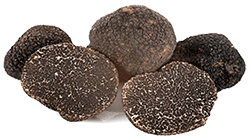
- The round, dark brown fruiting bodies have a black-brown skin with small pyramidal cusps.
- Black truffles normally reach a size of up to 10 cm/ 4''.
- Their flesh is initially white, then dark. It is permeated by white veins, which turn brown with age.
- The spores are elliptical and measure about 22–55 μm by 20–35 μm. They are dark brown and covered with large spikes.
- The fruiting bodies of the black truffle have a strong, aromatic smell. They exude a scent reminiscent of undergrowth, strawberries, wet earth, or dried fruit with a hint of cocoa.
- Their taste, which fully develops after the truffles are heated, is slightly peppery and bitter.
- If stored at room temperature, the aromatic compounds dissipate, while storage around the freezing point 0 °C leads to an increased synthesis of these compounds.
Carpinus betulus
- The European or common hornbeam is a deciduous small to medium sized tree reaching heights of 15 to 25 m.
- It requires a warm climate for good growth, and only naturally occurs below 1000 m in elevation.
- In England, the trees appear to prefer soils with a pH from 3.6 to 4.6 but tolerate up to pH 7.6.
- They are found on soils with moderate clay content and avoid soils with particularly high or low clay content.
- Carpinus betulus likes full sun or partial shade, moderate soil fertility and moisture.
- It is not very exigent on the nature of the soil, although prefers silty and fresh soils.
- It has a shallow, wide spreading root system.
- The hornbeam is a prolific seeder and is marked by vigorous natural regeneration. The seeds often do not germinate until the spring of the second year after sowing.
- Hornbeam grows in mixed stands with oak, and in some areas beech.
- It stands up well to repeated and severe cutting back and has dense foliage. The wood is heavy and hard, and is used for tools and building constructions. It also burns hot and slowly, making it very suitable for firewood.
- It grows relatively quickly, and is very resistant to frosts and heat.
- This tree has been associated with the poisonous mushroom Amanita phalloides, death cap mushroom, which grow around the trunk after hornbeams mature. Death cap mushrooms can be mistaken for other edible mushrooms like Amanita princeps.
1 to 3 year old plant, produced in France, quality controlled by INRAE.