The early bird gets the worm. Get ready for the coming season.
Nordmann Seedless Budwood
Nordmann Seedless Budwood
Δεν ήταν δυνατή η φόρτωση της διαθεσιμότητας παραλαβής
Fortunella margarita.
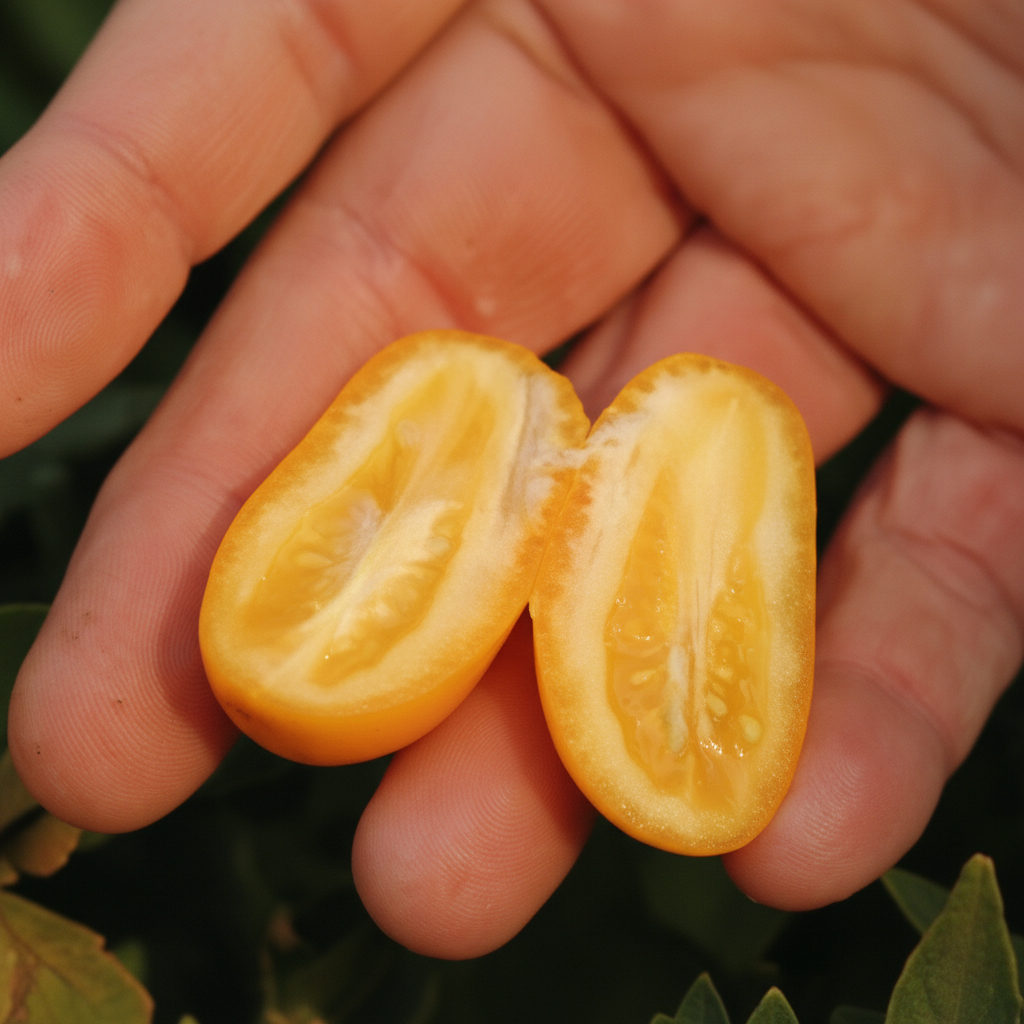
Similar to Nagami, with a slightly different shape, lighter colored skin, and no seeds. Medium size; teardrop shape, tapered toward stem end; rind thick, yellow-orange, sweet; pulp tart, fairly juicy; flavor like Nagami; seedless. The tree at the Citrus Variety Collection bears large crops, like Nagami. Fruit size is variable, but appears to be about the same as Nagami. Commercially grown in very small quantities in California.
The skin may be a little thinner than in Nagami, and postharvest life may be slightly shorter, both of which may perhaps be caused by the absence of plant hormones from the seeds.
The tree is similar to the standard Nagami kumquat, small to medium in size with a fine, dense texture. The tree becomes semi-dormant in winter, making it relatively cold-hardy. Flowering season is in summer and the fruit matures in winter, holding well on the tree. The fruits can be up to two inches long, three-quarters of an inch wide, and frequently hang in ornamental clusters.
On seedlessness in kumquats: Kumquats “have never been popular for [marmalades and jellies and candied fruits], probably owing to their seediness, wrote Herbert J. Webber in 1943. “If a seedless variety were developed, an extensive preserving and candying industry could be easily developed.”
In addition to ‘Nordman Seedless’, two partially or mostly seedless varieties have been developed and propagated in Texas, ‘Seedless Nameiwa’ and ‘Nameiwa #1’. (Loeblich, 1994).
Japanese breeders have developed a seedless kumquat cultivar named ‘Puchimaru’ which has the shape of Nagami, but is sweeter, like Meiwa. Several tetraploid kumquats exist is the United States and Asia, so it would be possible for breeders to create more seedless triploid varieties. (Yoshida et al., 2003)
Rootstocks of accession: C-35 citrange. A tree on Schaub Rough lemon appears to have incompatibility issues.
Season of ripeness in the Riverside climate and latitude: December to June.
Flowering season at Riverside: May to September.
Prepared by the Givaudan Citrus Variety Collection at The University of California Riverside.