The early bird gets the worm. Get ready for the coming season.
En Strip Parasitic Wasp
En Strip Parasitic Wasp
Impossible de charger la disponibilité du service de retrait
Scientific name: Encarsia formosa.
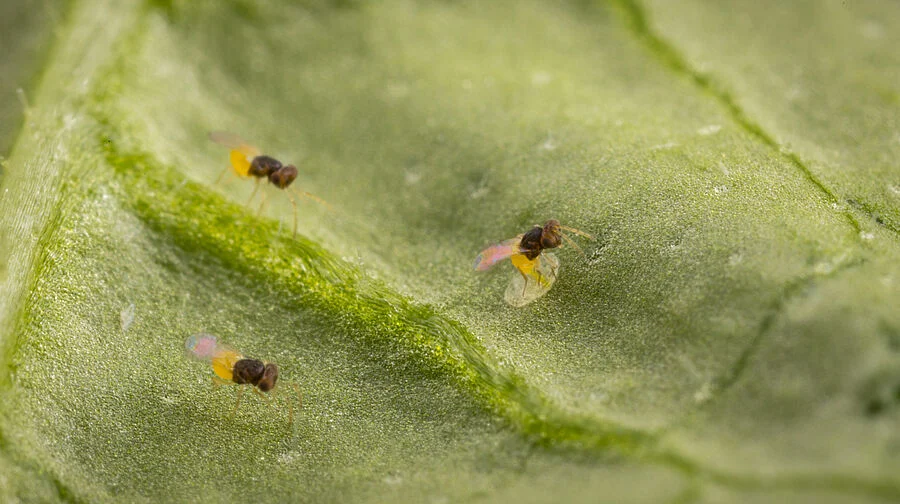
Encarsia formosa is one of the first parasitoid wasp species to be used commercially for biological pest control. The Chalcid wasp is a well known biocontrol agent of at least 15 whitefly species including Bemisia tabaci (silverleaf whitefly, sweet potato whitefly or cotton whitefly) and Aleyrodes proletella (cabbage whitefly) that are currently important agricultural pests globally.
Female Encarsia formosa parasitic wasps deposit 50 to 100 eggs individually inside the bodies of nymphs or pupae of the host species. The wasp larvae develop at optimum temperatures and wasp pupation occurs within the whitefly body.
Parasitized pest hosts are easily distinguished from unparasitized host pupae. Greenhouse whitefly pupae turn black in about 10 days, while parasitized sweet potato whiteflies turn amber brown.
In some countries Encarsia formosa is the primary biological control agent used to control greenhouse whiteflies, particularly on crops such as tomato which is a difficult plant for predators to establish themselves on.
Use for:
- For the control of whitefly, particularly greenhouse whitefly (Trialeurodes vaporariorum) and Tobacco whitefly (Bemisia tabaci).
- Effective at lower temperature range than Eretmocerus eremicus.
-
Can be used preventively or at first signs of pest presence.
-
En Strip is best to be used in combination with generalist predatory mites (Amblyseius andersoni, Amblyseius swirskii, Neoseiulus cucumeris or Amblydromalus limonicus) or, in tomato, with predatory mirid bugs (Macrolophus pygmaeus or Nesidiocoris tenuis).
Mode of action:
Adult female parasitic wasps parasitize the third and fourth larval stage of the whitefly. Additionally, host feeding also occurs.
Visually, parasitized Trialeurodes vaporariorum pupae turn black, Bemisia tabaci pupae become brownish. Adult wasps leave the pupae via a round hole.
Product specifications:
| Pack size | 3000, 7500, 15 000 pupae. |
| Presentation | Cardboard strips with 5 cards each, wrapped in plastic, in a cardboard box, each card holds 60 (30 for 7500 count product) parasitized whitefly pupae. |
| Carrier | None. |
Application:
- Open package carefully inside the greenhouse.
- Bend and tear off the strips opposite to the mounting hole.
- Make sure not to touch the pupae during handling.
- Suspend the cards in the crop, if possible approximately 75 cm under the plant head.
- Avoid to hang cards at places exposed to direct sunlight.
Dosage:
The dosage of En Strip depends on climate, crop and whitefly density and should always be adjusted to the particular situation. Start introduction preventively soon after planting of the crop. Introduction rates typically range from 1 to 10 per m2/release. Releases should be repeated until control is achieved. At increasing temperatures it may be better to switch to the use of different parasitic wasp species.
Environmental conditions:
- The parasitic wasp is most effective at temperatures between 20°C and 25°C / 68°F and 77°F.
-
At a 24 hours average temperature below 17°C / 63°F the control of whiteflies may be insufficient
Storage:
- Apply as soon as possible after receipt. If necessary, the product can be stored for 1 to 2 days.
- Store at temperatures of 8°C to 10°C / 47°F to 50°F.
- Store in the dark.
Caution:
- Pesticides can have direct or indirect effects on biological solutions.
- Only use products that are permitted in your country or state and crop.