The early bird gets the worm. Get ready for the coming season.
Black Truffle Inoculated Basswood
Black Truffle Inoculated Basswood
Prix habituel
$42.00 USD
Prix habituel
Prix soldé
$42.00 USD
Prix unitaire
par
Frais d'expédition calculés à l'étape de paiement.
Impossible de charger la disponibilité du service de retrait
Basswood plant, Tilia cordata, inoculated with black truffle, Tuber melanosporum spore.
Truffles are species of the genus Tuber.
They are ectomycorrhizal fungi, found in close, mutually beneficial association with tree roots.
Spore dispersal is accomplished through fungivores, animals that eat fungi.
These fungi have ecological roles in nutrient cycling and drought tolerance.
Tuber melanosporum
- The black truffle, French black truffle or Périgord truffle, Tuber melanosporum, associate with oaks, hazelnut, cherry and other deciduous trees.
- Black truffles are harvested in late autumn and winter. In the Northern Hemisphere, the fruiting bodies develop from April to June and are harvested from November to March.
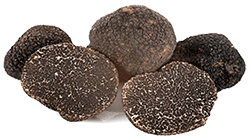
- The round, dark brown fruiting bodies have a black-brown skin with small pyramidal cusps.
- Black truffles normally reach a size of up to 10 cm/ 4''.
- Their flesh is initially white, then dark. It is permeated by white veins, which turn brown with age.
- The spores are elliptical and measure about 22–55 μm by 20–35 μm. They are dark brown and covered with large spikes.
- The fruiting bodies of the black truffle have a strong, aromatic smell. They exude a scent reminiscent of undergrowth, strawberries, wet earth, or dried fruit with a hint of cocoa.
- Their taste, which fully develops after the truffles are heated, is slightly peppery and bitter.
- If stored at room temperature, the aromatic compounds dissipate, while storage around the freezing point 0 °C leads to an increased synthesis of these compounds.
Tilia cordata
- The small leaved lime, little leaf linden or pry is a deciduous tree growing 20 to 40 m tall.
-
The trees favour loamy soil sites, but can also be found on sandy, infertile soils.
- Dormant shoots of T. cordata can resist winter frost temperatures as low as −34 °C.
- Pry trees can survive heavy pruning.
- Tilia cordata grows best in a soil pH range of 5.0 to 8.0.
- The tree prefers moist, well drained soil, and can survive flooding.
- It is not highly drought tolerant and does not do well in soils with high salinity.
1 to 3 year old plant, produced in France, quality controlled by INRAE.