The early bird gets the worm. Get ready for the coming season.
Chrysopa Predatory Lacewing
Chrysopa Predatory Lacewing
Kan beschikbaarheid voor afhalen niet laden
Scientific name: Chrysoperla carnea.
Chrysoperla carnea is a European common green lacewing species. Lacewings have a holarctic distribution however individual; species are highly restricted to specific geographic bounds of the northern hemisphere, with regards to temperature and elevation. Region specialized species of Chrysoperla insect forms are available in different countries to be used in the biological control of agricultural pests on commercial crops.
Common green lacewing adults are not predatory, they feed on nectar, pollen and aphid honeydew. The crepuscular or nocturnal lacewing adults recognize fresh green leaves, with the high green sensitivity of the superposition eyes, where they can find honey dew produced by aphids, a site for egg laying and a resting place. Each female lacewing lays several hundred small eggs at the rate of two to five per day, secured to the plant by a slender stalk, in choosen concealed spots underneath leaves or on shoots near potential prey, often where aphids are present nearby in numbers .
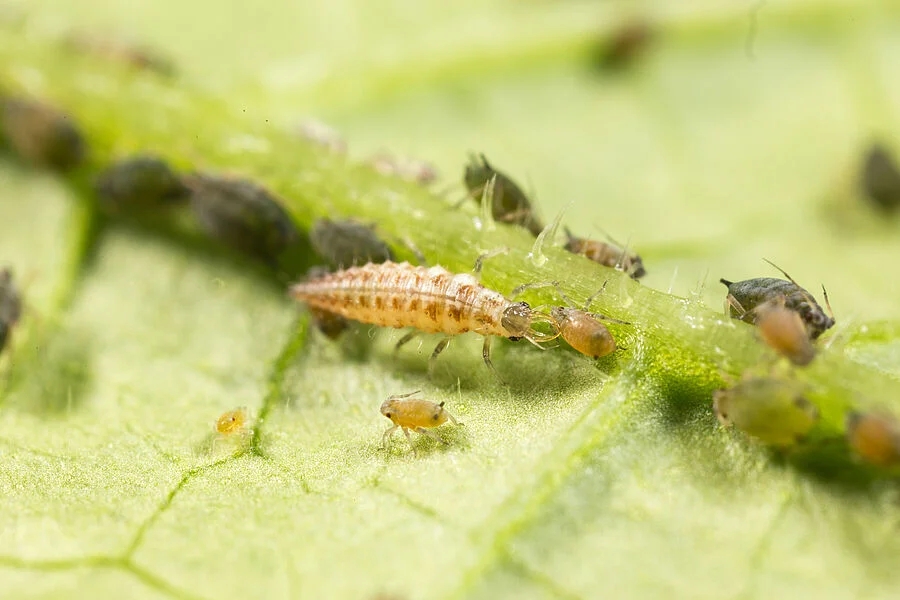
The larvae hatch in three to six days, eat voraciously and moult three times as they grow. For two to three weeks the maturing lacewing larvae will consume large numbers of prey, completely destroy aphid colonies and feed on other insects including larger creatures. When food is scarce and in confined conditions, they are highly aggressive and cannibalistic. Lacewing larvae have been recorded to consume seventy different prey species in five insect orders, mostly from the order Hemiptera. Naturally occurring, attracted and introduced lacewing larvae may be used to organically and ecologically control aphids, red spider mites, thrips, whitefly, the eggs of leafhoppers, leaf miners, psyllids, small moths and caterpillars, beetle larvae and the tobacco budworm, the long tailed mealybug and the presence of lacewing larvae on foliage inhibits visitation and oviposition of the cotton whitefly, Bemisia tabaci. The aphid lions resemble small alligators, crawling actively around in search of prey that they grasp with a pair of pincer like mandibles on their head sometimes lifting the victim off the leaf surface to prevent its escape. The lacewing larvae inject enzymes into the bodies of their victims which digest the internal organs, after which they suck out the liquidated body fluids for food.
Mature larvae spin circular cocoons and pupate in concealed positions on plants, from which lacewing adults emerge eleven to thirteen days later. The length of their life cycle is positively influenced by summer temperatures. The green lacewing adults overwinter buried in leaf litter at the edge of fields or other rough places, emerging when the weather warms up in spring. In open air environments adult lacewings tend to disperse widely, they may remain in the original release location if they have readily available sources of nectar, pollen or honeydew to feed on in the general vicinity.
*Exercise educated caution when using natural enemy biopesticides so beneficial and endemic insects and their larvae are not affected.
Use for:
-
Biological control of aphids, mealybugs, Echinothrips, butterfly and moth eggs, different thrips and other pest insects.
- Can be used in outdoor fields and indoor greenhouse cultivation.
- Can be used in combination with other aphid biocontrol agents.
-
Also effective at low temperatures.
Mode of action:
Larvae of the lacewing attack their prey and suck their body fluids.
Visually, prey is sucked out, shrivelled skins are difficult to find. Chrysoperla carnea is active mainly during the night. The larvae hide during the day.
Product specifications:
| Pack size | 1000, 10 000 larvae. |
| Developmental stage | 500 ml bottle, 6 litre bucket. |
| Concentration | Buckwheat hulls. |
Application:
- Shake the bottle or bucket gently before use.
- Apply on infested leaves.
- For hotspot treatments, apply Chrysopa directly in the heavily affected areas.
- The product can be applied on the rock wool slabs, on leaves, via application boxes or distributed by automatic blowers.
Dosage:
The dosage of Chrysopa depends on climate, crop and pest density and should always be adjusted to the particular situation. Start introduction as soon as the first pests are detected in the crop. Introduction rates typically range from 2 to 20 per m2/ release. Releases should be made in infested areas only and repeated at weekly intervals until control is achieved.
Environmental conditions:
Chrysoperla carnea is effective in a wide temperature range including low temperatures (average > 12°C / 54°F). It is most effective at 20°C to 28°C / 68°F to 82°F).
Storage:
- Apply as soon as possible after receipt. If necessary, the product can be stored for 1 to 2 days.
- Store at temperatures of 8°C to 10°C / 47°F to 50°F.
- Keep in the dark.
- Place the bottle horizontally.
Caution:
- Pesticides can have direct or indirect effects on biological solutions.
- Only use products that are permitted in your country or state and crop.