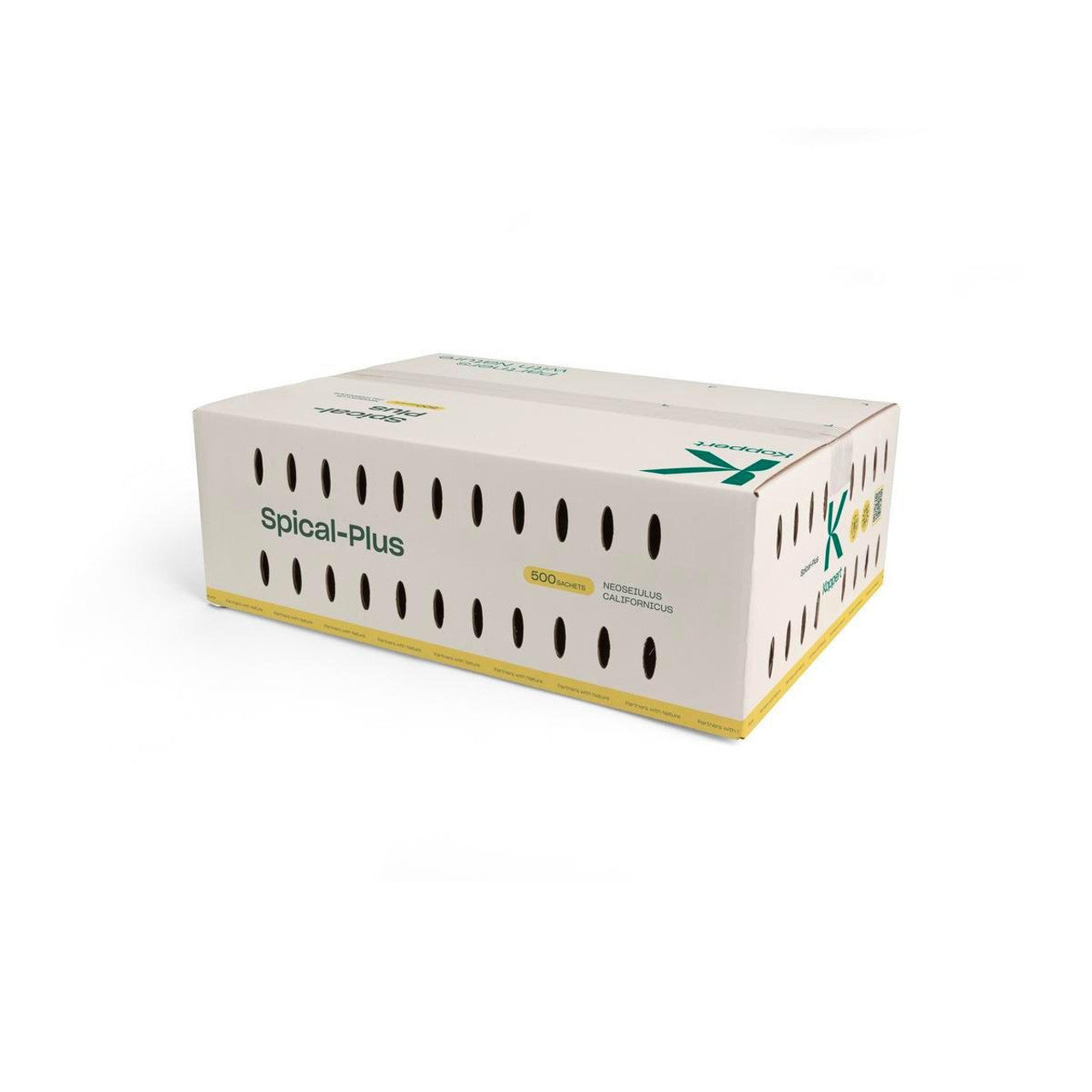
The early bird gets the worm. Get ready for the coming season.
Spical Plus Predatory Mite
Spical Plus Predatory Mite
Kan beschikbaarheid voor afhalen niet laden
Scientific name: Neoseiulus californicus.
Neoseiulus californicus, found on fruit and vegetable crops, is a member of the predatory mite family Phytoseiidae that feeds on Tetranychid mites, or spider mites, thrips and other mite species. This natural enemy of plant pests is used as a biological control agent of the two spotted spider mite (Tetranychus urticae), cyclamen mite (Phytonemus pallidus), Oligonychus perseae, thrips and other small insects in organic and conventional agriculture.
Use for:
- For the organic biological control of spider mites.
- Natural enemy of the two spotted spider mite (Tetranychus urticae), European red mite (Panonychus ulmi), citrus red mite (Panonychus citri), other spider mite species.
- For moderate climate conditions in protected crops.
-
More tolerant to high temperatures and low humidity than Phytoseiulus persimilis.
Mode of action:
Predatory mites reproduce within the sachet and gradually disperse into the crop over a period of several weeks. They pierce the prey with their sucking mouthparts and suck out the contents.
Product specifications:
| Pack size | 100 or 500 sachets. Each sachet contains 100 predatory mites and prey mites. |
| Presentation | Sachets in cardboard box. |
| Carrier | Bran. |
Application:
- Hang sachets in sheltered locations in the crop, not exposed to direct sunlight.
- Sachets already have an exit hole.
- Hold sachets by the cardboard strip at the top, to avoid damaging the predatory mites.
Dosage:
The dosage of Spical Plus depends on climate, crop and pest density and should always be adjusted to the particular situation. Start introduction preventively or as soon as the first spider mites are detected in the crop. Use at least 4000 sachets per ha and hang them evenly spaced in the crop. Release should be repeated after 4 weeks if the pest is not controlled.
Environmental conditions:
- Neoseiulus californicus is most effective at temperatures between 13°C and 32°C / 55°F and 90°F and is sensitive to relative humidity below 60%.
- Can be combined with Phytoseiulus persimilis and Feltiella acarisuga.
- Do not use in tomato plantations.
Storage:
- Apply as soon as possible after receipt. If necessary, the product can be stored for 1 to 2 days.
- Store at temperatures of 17°C to 20°C / 63°F to 68°F.
- Store in the dark, provide ventilation to prevent CO2 accumulation.
Caution:
- Pesticides can have direct or indirect effects on biological solutions.
- Only use products that are permitted in your country or state and crop.