The early bird gets the worm. Get ready for the coming season.
Swirski Mite Plus Predatory Mite
Swirski Mite Plus Predatory Mite
Kan beschikbaarheid voor afhalen niet laden
Scientific name: Amblyseius swirskii.
The Swirski mite, a species of predatory mite in the family Phytoseiidae, is also known as Typhlodromips swirskii, Amblyseius rykei or Neoseiulus swirskii.
Native to the eastern Mediterranean region, Amblyseius swirskii has been introduced in suitable climates around the globe as a biological pest control agent of the immature stages of western flower thrips Frankliniella occidentalis, common blossom thrips, onion thrips, melon thrips, chilli thrips, silverleaf whitefly, greenhouse whitefly, Asian citrus psyllid, broad mites and other herbivorous mites in vegetables and ornamentals grown under cover, greenhouse plantations, indoor grown crops and apple, apricot, citrus, cotton and vegetable fields.
The five day life cycle at 25 °C / 77 °F consists of the egg stage, one larval stage, two nymphal stages and an adult stage. The eggs laid on the undersides of leaves hatch into non feeding larvae soon develop into the nymphal stages before becoming adults. Both nymphs and adults are predatory. The mites are pale yellow or tan when thrips and whitefly are eaten and reddish on some other diets. When prey species are not available, the mites survive and reproduce on a diet of pollen and plant exudates, although at reduced fecundity and growth rates. Where two prey species are available, Amblyseius swirskii mites will prey on the most available one. The cultured mites can be mixed with bran and sprinkled on the crop or spread by air blast.
Use for:
-
Biological control of thrips and whitefly.
- Natural enemy of young larvae of various thrips species and eggs and larvae of whitefly.
-
For moderate climate conditions in protected crops.
Mode of action:
Predatory mites multiply in the sachet and disperse into the crop over a period of several weeks. They pierce the prey with their sucking mouthparts and suck out the contents.
Product specifications:
| Pack size | 100 or 500 sachets. Each sachet contains 250 predatory mites and prey mites. |
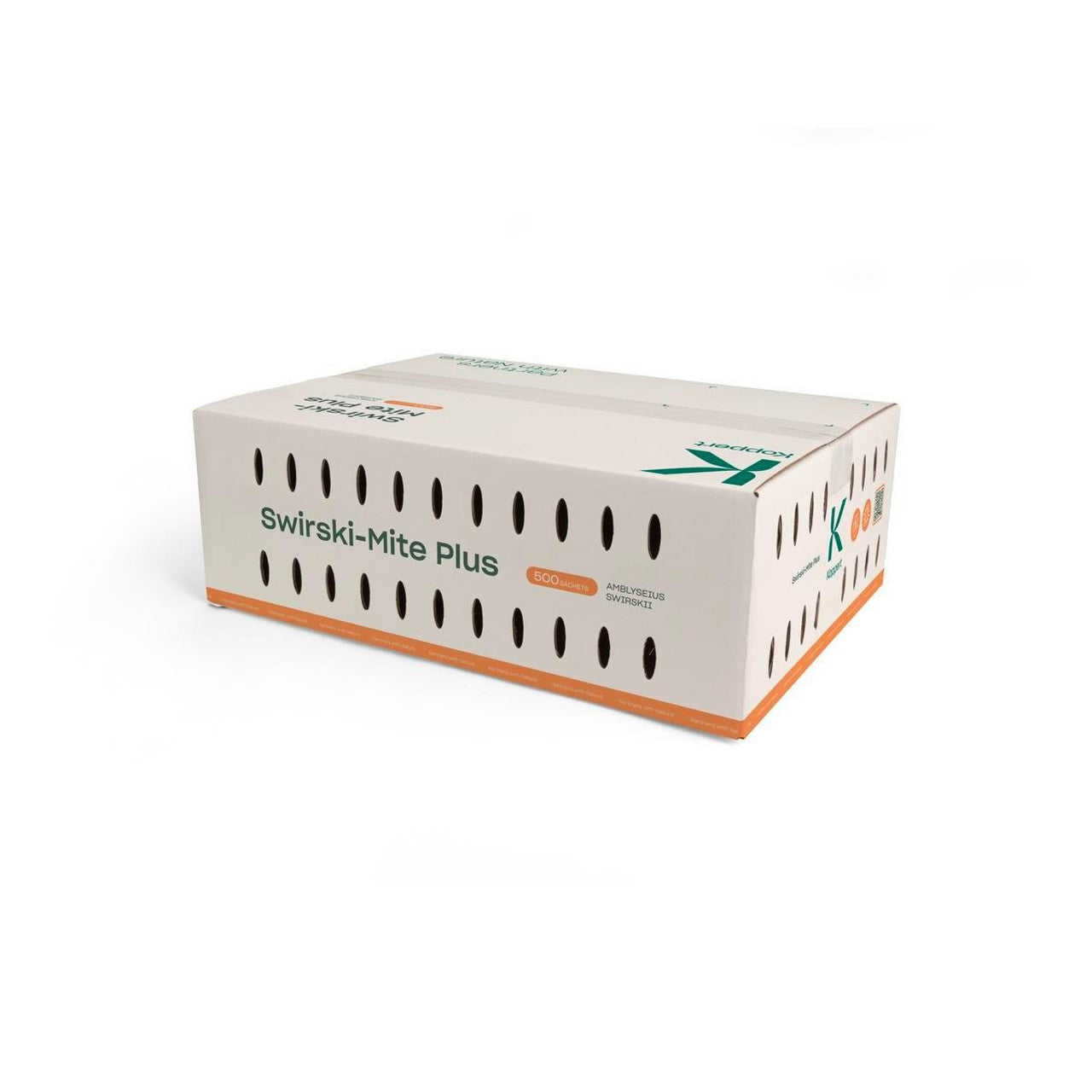
| Presentation | Sachets in cardboard box. |
| Carrier | Bran. |
Application:
- Hang sachets in sheltered locations in the crop, not exposed to direct sunlight.
- Sachets already have an exit hole.
- Hold sachets by the cardboard strip at the top, to avoid damaging the predatory mites.
Dosage:
The dosage of Swirski Mite Plus depends on climate, crop and pest density and should always be adjusted to the particular situation. Start introduction preventively or as soon as the first pest mites are detected in the crop. Use at least 4000 sachets per ha and hang them evenly spaced in the crop. Release should be repeated after 4 weeks if the pest is not controlled.
Environmental conditions:
- Amblyseius swirskii is most effective at temperatures between 20°C and 32°C / 68°F and 90°F. It is not effective at temperatures below 18°C / 64°F and above 36°C / 97°F. Amblyseius swirskii is sensitive to relative humidity below 60%.
- Can be combined with Orius spp. and whitefly parasitoids.
- Do not combine with other generalist predatory mites (Neoseiulus cucumeris, Amblydromalus limonicus, Transeius montdorensis, Amblyseius andersoni). It is difficult to distinguish one species of predatory mite from another in the field.
- Do not use in tomato crops.
Storage:
- Apply as soon as possible after receipt. If necessary, the product can be stored for 1 to 2 days.
- Store at temperatures of 12°C to 14°C / 54°F to 57°F.
- Store in the dark, provide ventilation to prevent CO2 accumulation.
Caution:
- Pesticides can have direct or indirect effects on biological solutions.
- Only use products that are permitted in your country or state and crop.