The early bird gets the worm. Get ready for the coming season.
Black Truffle Inoculated Rockrose
Black Truffle Inoculated Rockrose
常规价格
$42.00 USD
常规价格
促销价
$42.00 USD
单价
单价
结账时计算的运费。
无法加载取货服务可用情况
Rockrose plant, Cistus x incanus, inoculated with black truffle, Tuber melanosporum spore.
Truffles are species of the genus Tuber.
They are ectomycorrhizal fungi, found in close, mutually beneficial association with tree roots.
Spore dispersal is accomplished through fungivores, animals that eat fungi.
These fungi have ecological roles in nutrient cycling and drought tolerance.
Tuber melanosporum
- The black truffle, French black truffle or Périgord truffle, Tuber melanosporum, associate with oaks, hazelnut, cherry and other deciduous trees.
- Black truffles are harvested in late autumn and winter. In the Northern Hemisphere, the fruiting bodies develop from April to June and are harvested from November to March.
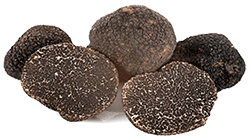
- The round, dark brown fruiting bodies have a black-brown skin with small pyramidal cusps.
- Black truffles normally reach a size of up to 10 cm/ 4''.
- Their flesh is initially white, then dark. It is permeated by white veins, which turn brown with age.
- The spores are elliptical and measure about 22–55 μm by 20–35 μm. They are dark brown and covered with large spikes.
- The fruiting bodies of the black truffle have a strong, aromatic smell. They exude a scent reminiscent of undergrowth, strawberries, wet earth, or dried fruit with a hint of cocoa.
- Their taste, which fully develops after the truffles are heated, is slightly peppery and bitter.
- If stored at room temperature, the aromatic compounds dissipate, while storage around the freezing point 0 °C leads to an increased synthesis of these compounds.
Cistus
- Species in the Cistus genus are perennial shrubs found on dry or rocky soils.
- They are thermophilous plants, which require open, sunny places.
- The plant genus has developed a range of specific adaptations to resist summer drought and frequent disturbance events, such as fire and grazing.
- It can form both ectomycorrhizas and arbuscular mycorrhizas. More than 200 ectomycorrhiza-forming fungal species belonging to 40 genera have been reported so far to be associated with Cistus.
- As with many other Cistaceae, the species of Cistus have the ability to form mycorrhizal associations with truffles and are thus able to thrive on poor sandy soils or rocks.
- Various Cistus species are known to emit volatile oils, rendering the plants flammable. Their emission of these essential oils is a genetic adaptation for the species intended to actually promote flammability and even cause spontaneous combustion. Cistus plants are therefore considered pyrophytes, or plants which rely upon fire as a part of their life cycle to encourage spread within their biome. Cistus seeds are resistant to the fires allowing them to germinate once fires have subsided.
1 to 3 year old truffle mycorrhized plant, produced in France, quality controlled by INRAE.