The early bird gets the worm. Get ready for the coming season.
Natupol Fly Natural Pollinator
Natupol Fly Natural Pollinator
受取状況を読み込めませんでした
Scientific name: Lucilia sericata.
Lucilia sericata is the commonly most known of the numerous green bottle fly species. Blowfly members, of the family Calliphoridae, alongside managed and wild bees are likely to be the main crop pollinating insects. They visit flowers to collect nectar for a source of carbohydrates. They are specially attracted to flowers with strong odors. The abundance of hairs on their body help them carry and transfer pollen to pollinate a wide range of plants, including crop plants like avocado, mango, onion, leek, carrot, cauliflower, amongst others. Compared to honey bees, blow flies are also active under a broader range of environmental conditions.
Use for:
- Seed crops on very small surfaces or crops that can only be pollinated by flies.
- Pollination of isolated crops, produced on a smaller scale, such as seed crops with just a few flowers or for crops that produce very little pollen.
- Crops of the Crucifer, Composite, Umbellifer and Lily family.
- Packaging prevents product from overheating.
Mode of action:
The flies search for nectar in the flower and thus come into contact with pollen. These pollen are not consumed by the flies but stick to their bodies. When a fly visits another flower the pollen are transferred to the pistils of the flower which is needed for pollination.
Product specifications:
Application:
- Put the required amount of pupae in a cup.
- Place the cup in the crop on the soil. Do not scatter the pupae in the crop.
- Protect the pupae from direct sunlight and moisture such as rain or condensation.
- The flies emerge over time, depending on the temperature.
- If outdoor temperature is below 18°C it is best to keep the pupae indoors at a temperature of 20°C to 25°C until the first flies start to hatch. Pupae can then be released in the crop.
Dosage:
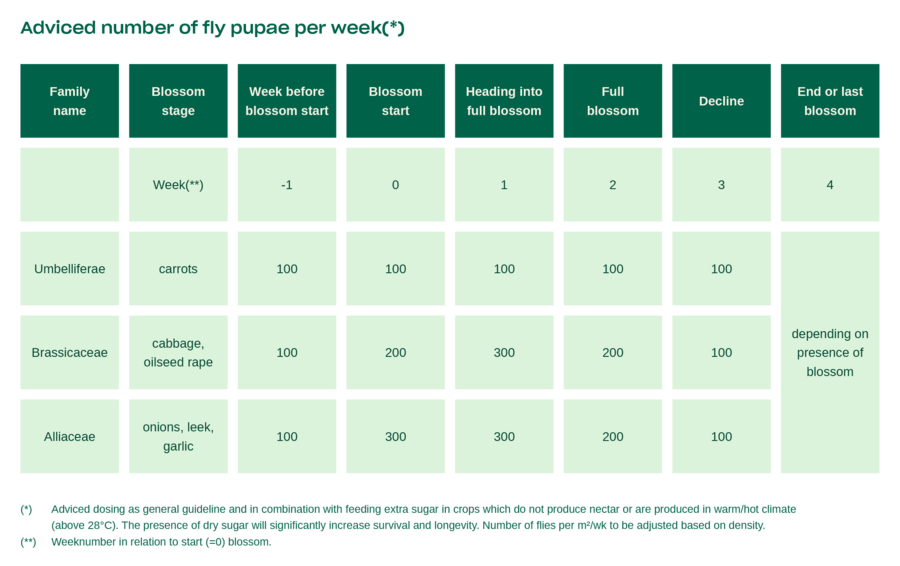
Adjust the quantity in relation to the number of flowers per m². As a general rule apply 100 to 300 pupae per m² per week. It is important to start introducing the first pupae the week prior to blossom since pupae need a couple of days to hatch. Please check the table below for crop specific advice.
Environmental conditions:
Natupol Fly performs best at ambient temperatures between 18°C and 28°C.
Storage:
- Pupae can be stored ideally 3 to 4 days or a maximum of 7 days.
- Keep at 3⁰C to 8⁰C.
- Store in a dry place out of reach of direct sunlight.
Hygiene:
- Remove bumblebee hives after flowering of the crop and no later than 12 weeks after introduction.
- After the pollination cycle, once there is no life in the bumblebee colonies, the Beehome system should be closed. Remove the plastic liner and the sugar water tank from the hive, then place the liner back inside. Seal the entire hive in a plastic bag, remove it from the crop area, and dispose of the sealed bag and sugar water tank in accordance with local waste disposal regulations.
Caution:
- Only use products that are permitted in your country or state and crop.
- Pesticides can have direct or indirect effects on biological solutions.