The early bird gets the worm. Get ready for the coming season.
Montdo Mite Plus Predatory Mite
Montdo Mite Plus Predatory Mite
Verfügbarkeit für Abholungen konnte nicht geladen werden
Scientific name: Transeius montdorensis.
Transeius montdorensis is commercially used preventively or at the beginning of a pest infestation, allowing the predatory mite population to establish before pest pressure becomes too high, for environment friendly integrated pest management in many protected and some non protected crops including medicinal crops, cucumbers, peppers, eggplants, strawberries and cut flowers.
Use:
- Generalist predatory mite for the control of thrips and whiteflies.
- Predates on young larvae of various thrips species, eggs and larvae of whitefly.
- Also has an effect on all stages of non webbing spider mites (e.g. European red mite, Panonychus ulmi) and rust mites.
- Can survive on pollen or other prey.
- Do not use in tomato.
- Can be combined with Orius spp. and whitefly parasitoids. Do not mix with other generalist predatory mites (Amblyseius swirskii, Neoseiulus cucumeris, Amblyseius andersoni and Amblydromalus limonicus).
Mode of action:
Predatory mites multiply in the sachet and disperse into the crop over a period of several weeks. They pierce the prey with their sucking mouthparts and suck out the contents.
Product specifications:
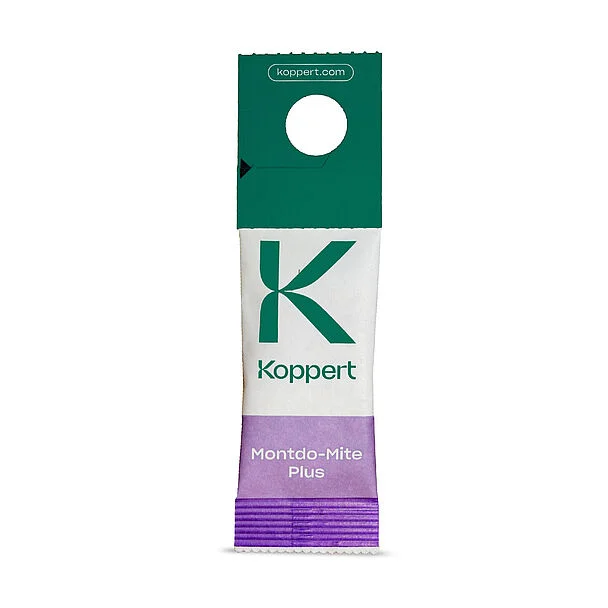
| Pack size | 500 sachets. Each sachet contains 250 predatory mites and prey mites. |
| Presentation | Sachets in cardboard box. |
| Carrier | Bran. |
Application:
- Hang sachets in sheltered locations in the crop, avoid placing into direct sunlight areas.
- Sachets already have an exit hole.
- Hold sachets by the cardboard strip at the top, to avoid damaging the predatory mites.
Dosage:
The dosage of Montdo Mite Plus depends on climate, crop and pest density and should always be adjusted to the particular situation. Start introduction preventively or as soon as the first pests are detected in the crop. Use at least 4000 sachets per ha and hang them evenly spaced in the crop. Release should be repeated after 4 weeks if the pest is not controlled.
Environmental conditions:
Transeius montdorensis is most effective at temperatures between between 20°C and 32°C / 68°F and 90°F). It is not effective at temperatures below 15°C / 59°F. Transeius montdorensis is sensitive to relative humidity below 70%.
Storage:
- Apply as soon as possible after receipt. If necessary, the product can be stored for 1 to 2 days.
- Store at temperatures of 12°C to 14°C / 54°F to 57°F.
- Store in the dark.
- Provide ventilation to prevent CO₂ accumulation.
Caution:
- Only use products that are permitted in your country or state and crop.
- Pesticides can have direct or indirect effects on biological solutions.