The early bird gets the worm. Get ready for the coming season.
Natupol Excel Bumblebee Greenhouse Natural Pollinator
Natupol Excel Bumblebee Greenhouse Natural Pollinator
Não foi possível carregar a disponibilidade de retirada.
Scientific name: Bombus terrestris.
Bombus terrestris, the buff tailed bumblebee or large earth bumblebee can survive in a wide variety of habitats, they are commonly found in numerous numbers throughout Europe and generally occupy cooler temperate climates but have escaped captivity after being introduced as a greenhouse pollinator in countries where they are not native and considered an invasive species in many of these places.
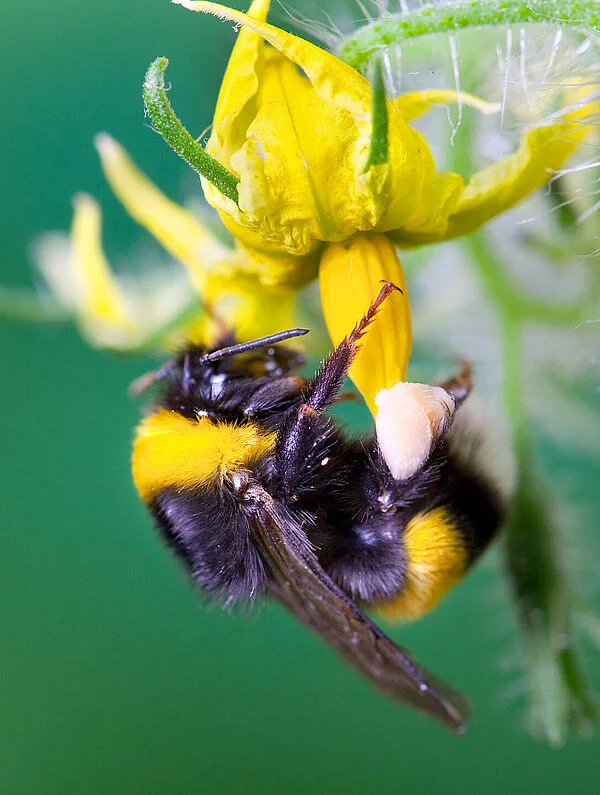
Commercial rearing of bumblebees provides a reliable, year round pollination source for indoor agriculture. Bumblebees (Bombus) are preferred over honeybees (Apis mellifera) for greenhouse crop pollination because of their superior efficiency and ability to perform in enclosed, often suboptimal, environments, in addition to the pollination of short period, intense flowering crops:
- In order to release the pollen, solitary bees are able to grab onto the flower and move their flight muscles rapidly, causing the flower and anthers to vibrate, dislodging pollen. This is known as buzz pollination or sonication. Crops such as tomatoes, peppers, and blueberries require this vibration, not performed by honeybees, to release their pollen effectively.
- Bumblebees primarily focus on foraging for pollen while honeybees are more focused on collecting nectar. Bumblebees typically visit more flowers per minute than honeybees in addition to their larger, hairier bodies enabling them to carry thus deposit more pollen.
- Bumblebees can forage at lower temperatures than honeybees and will continue to forage on cloudy, rainy or dim days when honeybees, preferring warmer temperatures, are more likely to remain in their hive.
- Bumblebees have a better sense of direction in indoor growing spaces where honeybees have difficulty navigating and orienting themselves within the enclosed structure of a greenhouse.
- Bumblebees are generally less aggressive than honeybees and do not swarm, creating a safer working environment for greenhouse personnel.
- If a honeybee scout finds a more attractive flowering crop outside the greenhouse, it can communicate this information to the rest of the hive, drawing a large workforce away from the target crop while bumblebees tend to focus their foraging efforts on the most readily available resources near their hive, which helps ensure consistent pollination of the crop inside the greenhouse.
- Bumblebee colonies are significantly smaller and have a shorter lifespan than honeybee colonies, making them easier to manage, contain and transport within a greenhouse setting.
B. terrestris are pollen storing bees that feed and forage on nectar and pollen. It is a eusocial insect with an overlap of generations, a division of labour and cooperative brood care. The queen is monogamous. Bumblebee nests are usually found underground. The foraging range and frequency of workers depends on the quality and distribution of available food, but most workers forage within a few hundred meters of their nest, learn flower colours and forage efficiently. B. terrestris generally forage on a large variety of flower species. Their highest activity is in the morning, with their peak time being noted at around 7 and 8 am. This is likely because it gets progressively warmer in the afternoon, and foragers prefer ambient temperatures of around 25 °C during nectar and pollen collection. Colonies produce between 300 and 400 bees on average. B. terrestris is unique compared to other bees in that their caste of workers exhibit a wide variation in worker size and exhibit alloethism, which is where different sized bees perform different tasks. This kind of behavior can be seen most often in foraging activities. Larger bees are more often found foraging outside the nest and will return to the nest with larger amounts of nectar and pollen. It is possible that larger bees might be able to withstand greater temperature variation, avoid predation, and travel larger distances making them selectively advantageous.
In cold climates, Bombus bumblebees have an annual life cycle. The nest is left abandoned by the died out colony in the autumn of temperate zones as a worker queen conflict forces the queen out who will die in or near the nest and the newly queenless workers will take care of the last brood and disperse and perish usually the jaws of predators while foraging. Drones leave the colony shortly after reaching adulthood to find a mate outside the nest. When the male drones emerge from the nest, they do not return, foraging only for themselves. If the nesting site is free of parasites one of the new queens will return and reuse that nest.
A new solitary bumblebee queen hatched from her abandoned colony initiates a new colony cycle when she leaves her natal nest daily looking for food, mates with a male and eventually finds a site to dig a hibernaculum where she will hibernate for the winter. When the queen emerges in spring, she seeks food to build up her ovaries and soon finds a new nesting site to found a new colony. The initiation phase of the new colony consists of the queen laying a small batch of diploid, fertilized, female eggs in the spring that she tends to herself, feeding them with nectar and pollen. Two weeks later, the first workers emerge, who forage for nectar and pollen for the colony and will tend to later generations of larvae. A switch point is reached where the queen begins to lay some haploid, unfertilized eggs, which develop into males. The remaining diploid eggs hatch into larvae that receive extra food and pupate to become new queens. The colony persists until fall in temperate zones and then workers begin to lay unfertilized eggs that if they mature will become males. At this point, outright aggression among workers and between the queen and workers begins. This is a predictable time point that occurs about 30 days into the colony cycle in very temperate climates. In warmer climates Bombus terrestris may skip the hibernation stage.
Use for:
- Bumblebee colony for protected crops producing a high amount of flowers and for crops grown under artificial light.
- Natupol Excel is developed for crops with a high amount of flowers per m² (35 to 60 flowers) per week, and for crops grown under artificial light or in warmer environments.
- Crops with >35 flowers/m2/week, such as cherry tomatoes and snack tomatoes, strawberries and other berries.
- Enhanced activity due to extra sugar water and ventilation.
- With UV Beevision print and blue Beehome door.
Mode of action:
After introduction of the hive, worker bumblebees start pollinating the flowers while at the same time collecting pollen to feed the brood. More workers emerge from the brood in the weeks after the introduction, increasing both colony size and pollination performance. After some weeks the colony will reach its maximum size and starts declining in size and pollination activity. Colony development depends on environmental conditions and the amount and quality of pollen.
Product specifications:
Application:
- Place the hive on a horizontal platform (avoid inclination, otherwise sugar water may leak).
- Position the hive about 20 cm to 60 cm above the ground in the shade of the crop or if necessary provide additional shading.
- Under short day conditions (<10 hours light) position the hive near the top of plants, in such a way that the hive is exposed to the first daylight.
- Wait for at least 15 minutes after positioning the hive before opening the hive entrance, this allows the bumblebees to calm down.
- Pull the blue sliding door of the hive upward until two openings become visible (entrance and exit). Do not remove the small grey door under the lid.
- Pollination performance and duration varies per crop and depends on environmental conditions.
Environmental conditions:
Natupol Excel performs best at ambient temperatures between 12°C and 30°C. Pay attention to advice for best practice under conditions with artificial light or in hot environments.
Storage:
- To guarantee the best pollination results, start using the hive on the day of arrival. If necessary hives can be stored for maximum 1 day.
- Store at 15°C to 25°C.
- Keep hives in a well ventilated environment, out of reach of direct sunlight during the temporary storage time.
Hygiene:
- Never move a hive from one greenhouse to another.
- Remove bumblebee hives the latest 10 weeks after introduction.
- Clean the hive stand before placing new hives.
- After the pollination cycle, once there is no life in the bumblebee colonies, the Beehome system should be closed. Remove the plastic liner and the sugar water tank from the hive, then place the liner back inside. Seal the entire hive in a plastic bag, remove it from the crop area, and dispose of the sealed bag and sugar water tank in accordance with local waste disposal regulations.
Caution:
- Only use products that are permitted in your country or state and crop.
- Pesticides can have direct or indirect effects on biological solutions.