الطائر المبكر يحصل على الدودة. استعد للموسم القادم.
Black Truffle Inoculated Turkish Hazel
Black Truffle Inoculated Turkish Hazel
Regular price
$42.00 USD
Regular price
Sale price
$42.00 USD
Unit price
per
Shipping calculated at checkout.
Couldn't load pickup availability
Turkish hazel plant, Corylus colurna, inoculated with black truffle, Tuber melanosporum spore.
Truffles are species of the genus Tuber.
They are ectomycorrhizal fungi, found in close, mutually beneficial association with tree roots.
Spore dispersal is accomplished through fungivores, animals that eat fungi.
These fungi have ecological roles in nutrient cycling and drought tolerance.
Tuber melanosporum
- The black truffle, French black truffle or Périgord truffle, Tuber melanosporum, associate with oaks, hazelnut, cherry and other deciduous trees.
- Black truffles are harvested in late autumn and winter. In the Northern Hemisphere, the fruiting bodies develop from April to June and are harvested from November to March.
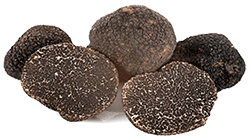
- The round, dark brown fruiting bodies have a black-brown skin with small pyramidal cusps.
- Black truffles normally reach a size of up to 10 cm/ 4''.
- Their flesh is initially white, then dark. It is permeated by white veins, which turn brown with age.
- The spores are elliptical and measure about 22–55 μm by 20–35 μm. They are dark brown and covered with large spikes.
- The fruiting bodies of the black truffle have a strong, aromatic smell. They exude a scent reminiscent of undergrowth, strawberries, wet earth, or dried fruit with a hint of cocoa.
- Their taste, which fully develops after the truffles are heated, is slightly peppery and bitter.
- If stored at room temperature, the aromatic compounds dissipate, while storage around the freezing point 0 °C leads to an increased synthesis of these compounds.
Corylus colurna
- This is a large species of hazel reaching 25 to 30 m tall.
- Corylus colurna is commonly used as a single stemmed, non suckering rootstock for common hazel, Corylus avellana, scions.
- C. colurna occurs in a wide altitudinal range between 100 and 1700 m, mostly on shallow, nutrient poor lime soils.
- Corylus colurna has a medium growth rate.
- It prefers moist, well drained soil, and full sun.
- Once established C. colurna is tolerant of heat, cold, drought and alkaline soil.
1 to 3 year old plant, produced in France, quality controlled by INRAE.