الطائر المبكر يحصل على الدودة. استعد للموسم القادم.
White Truffle Inoculated Pubescent Oak
White Truffle Inoculated Pubescent Oak
Regular price
$277.00 USD
Regular price
Sale price
$277.00 USD
Unit price
per
Shipping calculated at checkout.
Couldn't load pickup availability
Pubescent oak plant, Quercus pubescens, inoculated with white truffle, Tuber magnatum spore.
Truffles are species of the genus Tuber.
They are ectomycorrhizal fungi, found in close, mutually beneficial association with tree roots.
Spore dispersal is accomplished through fungivores, animals that eat fungi.
These fungi have ecological roles in nutrient cycling and drought tolerance.
Tuber magnatum
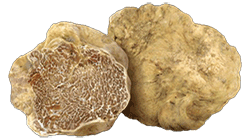
- The white truffle, tartufo bianco, can reach 12 cm in diameter and 500 grams, though are usually much smaller.
- Fruiting in autumn, the flesh is pale cream or brown with white marbling.
- White truffles grow symbiotically with oak, hazel, poplar and beech.
- The most common host plants cited in the literature are oaks, including associations with Mediterranean species Q. pubescens, Q. cerris and Q. ilex, and temperate species Q. robur and Q. petraea.
- The second most common host plant cited are poplars, mainly Populus alba, but also P. nigra, P. tremula, P. canadensis and P. deltoides.
- Among willows, four species are listed Salix caprea, S. alba, S. purpurea and S. apennina.
- Less commonly, they are associated with five other species of host plants, each from different genera: Abies alba (conifer), Alnus cordata (alder), Fagus sylvatica (beech), Pyrus pyraster (pear) and Ulmus minor (elm).
- The soils white truffles grow in have an average pH level of ~ 7.7, but it ranges from neutral to alkaline. In comparison, Tuber melanosporum, Périgord truffles are restricted to alkaline environments.
- The soil white truffles grow in varies in composition, from 20% clay or more, or 45% silt and <20% clay. In opposition to Tuber melanosporum which needs well drained soils with higher sand/ silt content. Much depends on the vertical repartition of mineral and organic matter, determined during initial soil formation due to flooding. Sediments high in carbonates, 15% to 10%, 14% to 4.5% organic matter content, relatively low nitrogen content 0.19 to 0.26% which corresponds to relatively slow decomposition rates, or higher C/N ratios in areas exposed to very regular flooding, inducing faster decomposition rates and elevated microbial activity in the uppermost soil layer.
- Fruit bodies, ascocarps, need at least 0.4 °C during their formation, which occurs in winter, therefore their distribution range is roughly limited to the north, although this limit may be modified by localised microclimatic pockets.
- This fungi thrives best at sites with ~ 13 °C per year, with average annual temperature ranges of ~ 12 °C in Mar–May, 22 °C in Jun–Aug, 14 °C in Sep–Nov, and 5 °C for Dec–Feb.
- The warmest mean air temperature for growth in Jun–Aug is 24.3 °C, about four degrees above the physiological optimum for mycelial development in soil. Temperatures in excess of this limit reduce the amount of mycelium in the topsoil on about 10 cm.
- Drought induced stress reduces the amount of mycelium in general. But T. magnatum is less tolerant than T. melanosporum and T. uncinatum of short term precipitation deficits in summer because its peridium is not as well developed. But it also means that T. magnatum is more tolerant of summer excess precipitation.
Quercus pubescens
- The downy oak, or Italian oak, is a species of white oak.
- Quercus pubescens is a medium sized, long lived deciduous tree growing up to 20 m tall.
- Forest grown trees grow tall, while open growing trees develop a very broad and irregular crown.
- Downy oaks typically grow in dry, lime rich soils.
- It is a sub Mediterranean species, growing from the coastline to deep in the continent.
- Its optimum is in transitional Mediterranean-oceanic climates, characterized by warm to hot, dry summers and cool (though not mild) winters with ample precipitation.
1 to 3 year old plant, ready to be planted in a truffle field, produced in France, quality controlled mycorrhization by INRAE.
Early reservation required.